











Factories everywhere are running a tighter game. Post-2023 supply-chain whiplash, relentless cost pressure, and a labor squeeze now land on the shop floor at once—forcing leaders to rethink systems fast.
A modern ERP such as Microsoft Dynamics 365 can help—but software alone never fixes a plant. People and process know-how do. Here’s the brutal truth: more than seventy percent of ERP projects miss their business-case goals, according to Gartner. The usual culprit? A partner who understands code but not a bill of materials.
We set out to change that. Our team crunched analyst reports, community threads, case studies, and Microsoft award data to rank the seven firms that consistently deliver for manufacturers. Inside, you’ll find an evidence-based scorecard, quick partner profiles, and a down-to-earth decision guide.
Ready to meet the shortlist?
Table of Contents
How we ranked the partners

You deserve more than a hunch. Before any firm made our list, we built a scoring model that treats selection like an engineering problem: define the specs, gather the data, run the numbers.
First, we mapped the pain points manufacturers cite most—missed go-live dates, weak shop-floor features, consultants who disappear after launch—to the factors a partner can control. That produced seven criteria: manufacturing track record, Microsoft accolades, industry IP, third-party recognitions, delivery scale, customer satisfaction, and innovation focus.
We then set weightings to match business impact. Track record counted for 25 percent, Microsoft credentials for 20, and the rest stepped down to innovation at 5 percent. Every partner earned a one-to-five score in each category, backed by evidence such as case counts, Inner Circle badges, and public review sentiment.

Finally, we multiplied, summed, and sorted. The math surfaced a clear top tier—seven firms that outperform across the board. They are the ones you will meet next, starting with the highest scorer.
Keep this transparent method handy as you compare partners against your own priorities.

1. MCA Connect (Grant Thornton)
MCA Connect tops our list for one reason: every move begins and ends on the factory floor.
The Denver-born firm focuses 100 percent on manufacturing and distribution, not retail, banking, or healthcare. That clarity pays off. Microsoft has named MCA Global Supply Chain Partner of the Year three times, and community buzz backs it up. One veteran on Reddit said, “I’ve never once come across a failed MCA project.”
Grant Thornton acquired MCA Connect in May 2026, adding the boutique’s 350-person Dynamics team to a wider consulting platform. For you, that means specialist know-how paired with global reach, analytics strength, and a deep change-management bench.
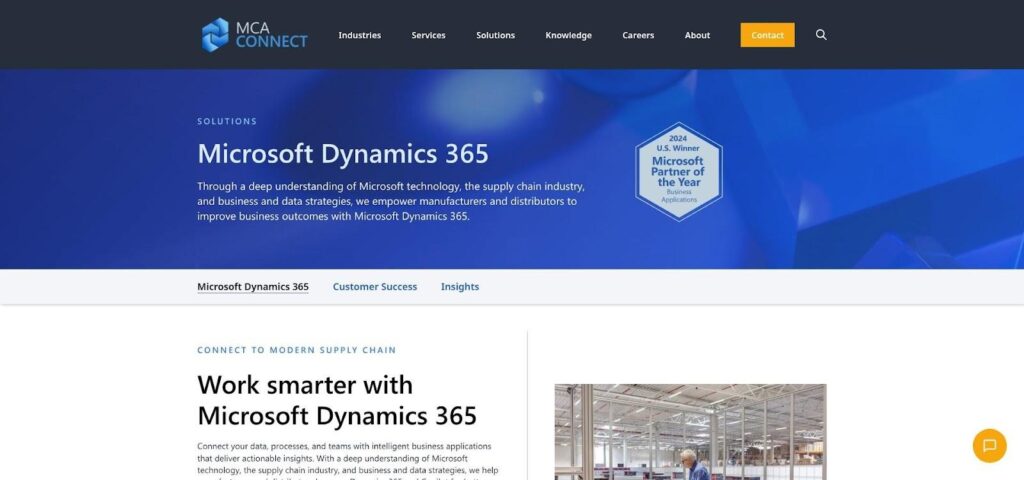
MCA Connect Microsoft Dynamics 365 manufacturing solutions website screenshot.
Ready-made manufacturing IP sets MCA apart: its Demand-Forecast and Fixed-Interval Scheduling extensions plug into Dynamics 365 without months of custom code, cutting time-to-value for multi-plant rollouts. The blueprint follows the Microsoft 365 supply chain solutions approach of pairing real-time demand planning, connected shop-floor visibility, and AI-guided asset care inside a single platform, so plants adopt proven patterns instead of reinventing them.
Combine that with a track record of rescuing troubled projects and a culture that keeps senior architects close to the shop floor, and you get a partner built to de-risk complex mixed-mode environments.
Choose MCA Connect when precision, speed, and reliable delivery matter more than a marquee name. You’ll work with a team that “speaks BOM and throughput” on day one, with results to prove it.
2. Itransition
Itransition combines Microsoft Dynamics 365 expertise with custom software engineering, making it a strong option for manufacturers that need more than a standard ERP implementation. Its approach connects production, inventory, finance, and supply chain processes while accommodating existing business systems.
The company’s manufacturing capabilities cover production planning, materials requirements planning, capacity scheduling, quality control, and supply chain management. Alongside Dynamics 365 Business Central and Finance & Supply Chain Management, Itransition offers system integration and customization to help manufacturers adapt ERP functionality to their operational requirements.
Integration is where Itransition stands out. Its software engineering expertise can help connect Dynamics 365 with existing enterprise applications and logistics systems, improving data visibility and coordination across business functions. In a food manufacturing and distribution project, the company reported a 30% improvement in operational efficiency and 95% user adoption within three months.
Choose Itransition when your manufacturing operation needs a tailored Dynamics 365 solution that connects ERP with existing systems and complex workflows. If your priorities include advanced shop-floor automation, predictive maintenance, or multi-plant standardization, ask for references demonstrating those capabilities in comparable manufacturing environments.
3. Hitachi Solutions
Hitachi Solutions blends a century of manufacturing DNA with deep Microsoft expertise, giving it an edge when ERP, IoT, and AI must work in harmony.
In 2023 Microsoft gave the firm a rare double win: Dynamics 365 Services Partner of the Year and Dynamics 365 Supply Chain Partner of the Year. Awards matter, but what you feel on the plant floor is speed. The firm’s “Sprint to Value” method breaks large projects into eight-week bursts, so teams see real MRP runs and inventory insights well before full rollout.
Convergence is where Hitachi excels. Consultants connect Dynamics 365 with Azure IoT, Power Platform, and even legacy MES, turning machine telemetry into proactive work orders and clear OEE dashboards. A footprint across North America, Europe, and Asia lets the same template roll from Nagoya to Nashville without translation headaches.
Choose Hitachi Solutions when your brief reads like an Industry 4.0 wish list: predictive maintenance, AI demand sensing, sustainability reporting, and a single version of truth across continents. The company brings the toolkit and track record to turn those goals into reality.
4. Avanade (Accenture)
Avanade is the heavyweight in this field. Born as a joint venture between Microsoft and Accenture, it counts more than 50,000 specialists focused only on the Microsoft stack—a depth no rival matches.
That focus shows in the trophy cabinet. Avanade has taken Microsoft’s Global SI Partner of the Year a record eighteen times, along with the 2023 Dynamics 365 Sales and Marketing award. Scale turns into practical benefits: follow-the-sun development, bilingual teams for multi-country launches, and dedicated change-management pros who speak finance, operations, and plant maintenance with equal fluency.
Manufacturers also gain Avanade’s research muscle. The firm pilots new Dynamics 365 Copilot features months before release and ships accelerators like Smart Maintenance, which ties Asset Management to Azure IoT for predictive service. Its 2022 purchase of eLogic added expertise in complex industrial equipment and SAP coexistence, making Avanade a safe bet when your landscape spans more than Microsoft.
One caution: with a pool this large, secure the A-team. During selection, meet the proposed solution architect and project manager, then lock them into the contract. Do that, and Avanade’s vast toolkit becomes your competitive edge.
5. HSO (“The Results Company”)
HSO offers a Goldilocks fit: large enough for global rollouts, focused enough that manufacturing never feels like an afterthought.
The Dutch-rooted firm has sat inside Microsoft’s elite Inner Circle for nineteen consecutive years, and in 2023 it won the Dynamics 365 Finance Partner of the Year award. That consistency signals tight alignment with Microsoft’s roadmap, useful when your CFO asks about the next wave of Finance insights or Copilot features.
On the shop floor, HSO leans on its Manufacturing Suite accelerator. Out-of-the-box templates for production scheduling, quality holds, and MES hand-offs trim weeks from timelines, while bundled Power BI dashboards deliver real-time OEE without custom cubes. Clients praise HSO’s disciplined methodology: weekly steering calls, strict change control, and a bias toward configuration over code. The approach feels spartan, yet projects land on the date printed in the charter.
A recent Bain Capital investment is fueling HSO’s AI roadmap, with predictive maintenance bots and intelligent supply-chain agents already live in early-adopter plants. If you want a partner that blends financial rigor with factory know-how and you value process over flash, HSO is your sweet spot.
6. RSM US
If you run a mid-market factory, RSM feels like the partner next door—large enough to provide bench strength, yet close enough that a partner still shows up on-site.
The firm grew up in audit and tax, so financial discipline runs deep. That DNA paid off in 2024 when RSM earned five Microsoft Partner of the Year finalist nods, including Dynamics 365 Finance. For manufacturers juggling standard costing, compliance, and tight cash cycles, a partner fluent in finance and production is gold.
RSM’s manufacturing playbook revolves around pre-configured solutions. Food processors get recipe and lot-trace templates, while industrial equipment makers see field-service and project-accounting pipelines already wired. These accelerators contain scope and keep budgets sane, which is why many private-equity-backed plants choose RSM when timelines are strict.
One caution: Reddit threads cite occasional over-stretch on complex global rollouts. The fix is simple. Lock scope early and lean on RSM’s upfront business-process review. When projects stay in that sweet spot—single-entity or limited entities with clear requirements—RSM delivers, then stays with managed services so your small IT team can rest easy.
Pick RSM when you want a peer who speaks GAAP in the morning and lean manufacturing in the afternoon, all without the sticker shock of a global SI.
7. Columbus Global
Columbus quietly dominates process manufacturing, a world where recipes, catch weights, and strict compliance rules can break lesser ERPs.
With more than thirty years on the Dynamics platform and twenty consecutive years in Microsoft’s Inner Circle, the Denmark-born firm understands both discrete and process complexities. Its signature ColumbusFood and ColumbusManufacturing add-ons plug into Dynamics 365, handling quirks like by-product tracking or variable-weight labeling without custom code. That leads to quicker go-lives and fewer version-lock headaches.
Clients value Columbus’ template-based rollout model. The team builds a core configuration at headquarters, then clones it to each plant, adding local tax and labeling tweaks during sprint reviews. For mid-sized multinationals, this strikes a balance between global consistency and local control.
Fit matters. Columbus excels in the upper-mid market. If your footprint spans fifty plants across four continents, parallel workstreams could stretch the team. For food, chemical, or hybrid make-and-distribute companies modernising a handful of sites, Columbus delivers Nordic efficiency, deep domain IP, and a record of getting ERP live on recipe and on time.
8. sa.global
sa.global rounds out our list by owning a niche most partners skip: project-driven manufacturing. Think capital-equipment builders, aerospace contractors, or engineer-to-order shops where every order looks different and margins hide inside project accounting.
An eleven-time Microsoft Partner of the Year winner or finalist, sa.global has deployed Dynamics since the 1990s and now operates in more than eighty countries. That reach matters when projects span design in Germany, fabrication in India, and commissioning in the United States.
The firm’s evergreen and empower IP fuses Dynamics 365 Project Operations with Finance and Supply Chain, so engineers, planners, and accountants all view the same WBS, budget, and BOM. The outcome is real-time cost visibility with no surprises at 90 percent completion.
Because sa.global grew up in professional-services ERP, its consultants focus on resource utilisation, milestone billing, and earned-value tracking. Those skills fit plant expansions or one-off machinery builds where cash flow depends on progress payments.
Fit is everything. If you mass-produce fast-moving goods, another partner may serve you better. If revenue arrives through lumpy, high-value projects that still need shop-floor control, sa.global supplies the rare blend of project IQ and manufacturing expertise to keep both schedules and profits on track.
Honorable mentions
A few respected names fell just short of our top tier but deserve a look if their sweet spot matches yours.
- Alithya (Fullscope). Focuses on North American mid-market plants, packaging decades of discrete-manufacturing wisdom into its DiscreteXpress rapid-deploy template. If you want Copilot-ready features without global complexity, add them to your shortlist.
- HCL PowerObjects. Built its reputation on CRM and field service. Manufacturers heavy on after-sales support or equipment rental can use PowerObjects to weave customer service, IoT alerts, and core ERP into one flow.
- DXC Technology. Once led Dynamics 365 in Europe and still brings enterprise scale, yet recent talent churn means outcomes vary by region. Vet the proposed team; the right local unit still delivers.
- Sunrise Technologies. Now under the Avanade umbrella, Sunrise shines in fashion, textile, and retail manufacturing, supplying deep color-size-style logic that generic partners often miss.
- Regional boutiques. Firms such as Clients First (aerospace SMBs) or ArcherPoint (Business Central for make-to-stock) can outperform giants when their micro-vertical lines up exactly with yours. Balance brand power against domain focus before signing.
How to choose the right partner
Start with brutal self-assessment. Map the project’s true complexity: number of plants, mix of process and discrete, integration count, and executive appetite for change. A clear-eyed scope prevents overselling and guides partner fit.

Match size to scope. Global rollouts that cross oceans call for the follow-the-sun capacity of Avanade or Hitachi. A single-country upgrade with tight budgets favors the pragmatism of RSM or the template efficiency of Columbus. Align partner scale with project heft, not ego.
Demand industry proof. Ask for two reference calls from manufacturers that mirror your volume, mode, and regulatory load. Listen for hard metrics: days of inventory cut, schedule adherence, cost variance. Generic success stories keep no line running.
Meet the actual team. Interview the proposed solution architect and project manager, not the sales lead. Lock key roles into the contract so they stay through go-live.
Probe methodology. Top partners favor configuration over custom code and weave user training into every sprint. When change management sits as an afterthought, the go-live stalls on the shop floor.
Negotiate full transparency. A credible partner presents a phased plan, separates must-have from wish list, and flags risks upfront. Pick the firm that states what could go wrong and explains how the two parties plan to tackle issues together. Such candor predicts a partner who answers the phone long after go-live.
Frequently asked questions
Which Dynamics 365 edition fits manufacturing best: Finance & Supply Chain or Business Central?
Finance & Supply Chain (often called F&O) offers advanced multi-site planning, shop-floor control, and complex costing. Business Central is lighter, faster to deploy, and suits smaller manufacturers with straightforward processes. Match the platform to transaction volume and regulatory load, not headcount.
How long does an implementation take?
A single-entity, finance-only launch lands in six to nine months. Adding advanced supply-chain modules, integrations, or multiple plants extends the timeline to twelve to eighteen months. Partners that promise eight-week “sprints” usually refer to a pilot or phase, not the full program.
What inflates budgets most often?
Scope creep, poor data quality, and underfunded training. Successful projects lock scope early, cleanse data in parallel, and dedicate at least ten percent of the budget to education.
Can we integrate an existing MES?
Yes. Dynamics 365 exposes modern APIs, and many partners provide connectors to common MES and PLC platforms. Plan for rigorous testing that simulates shop-floor exceptions, not just sunny-day transactions.
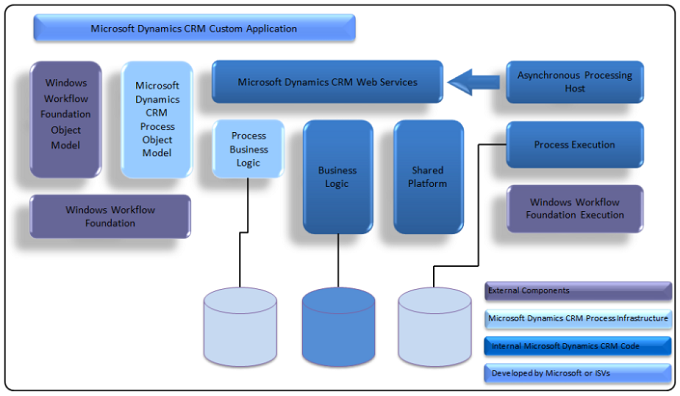
Dynamics 365 and MES integration architecture diagram for manufacturing plants.
Fixed fee or time-and-materials: which is safer?
For discovery and design, a capped T&M contract keeps flexibility. For a clearly defined build with few unknowns, fixed fee works. The key is transparency: require a detailed work-breakdown structure so you see exactly what the price covers before signing.
What happens if the chosen partner falters mid-project?
First, escalate inside the firm; top partners often swap resources or reset governance to steady the effort. If issues persist, switch partners after a milestone such as a data-migration dry run or design freeze, which limits knowledge-transfer pain. Keep all project artifacts in your own repository from day one to ease any transition.
Conclusion and next steps
Choosing an ERP partner is less about flashy slide decks and more about who stands beside you when the production line stalls at 2 am.
We reviewed dozens of firms, ran objective scores, and surfaced seven partners that consistently deliver for manufacturers. Each offers a distinct edge—pure-play focus, global scale, process depth, or project savvy. Match those strengths to your reality and you set the stage for an on-time, on-budget rollout that drives throughput.
Action plan:
- Assemble a cross-functional team (finance, IT, operations, and a plant lead). Early alignment prevents costly rework.
- Shortlist two or three partners from this guide and share an executive-level process map. Ask each firm for a rough timeline, risk log, and résumés of the exact people assigned to your project.
- Call at least two manufacturing references per candidate. Probe for hard outcomes such as inventory turns, schedule adherence, and payback period.
- Choose the partner that balances cost, culture, and capability, then lock scope, milestones, and key personnel into the contract.
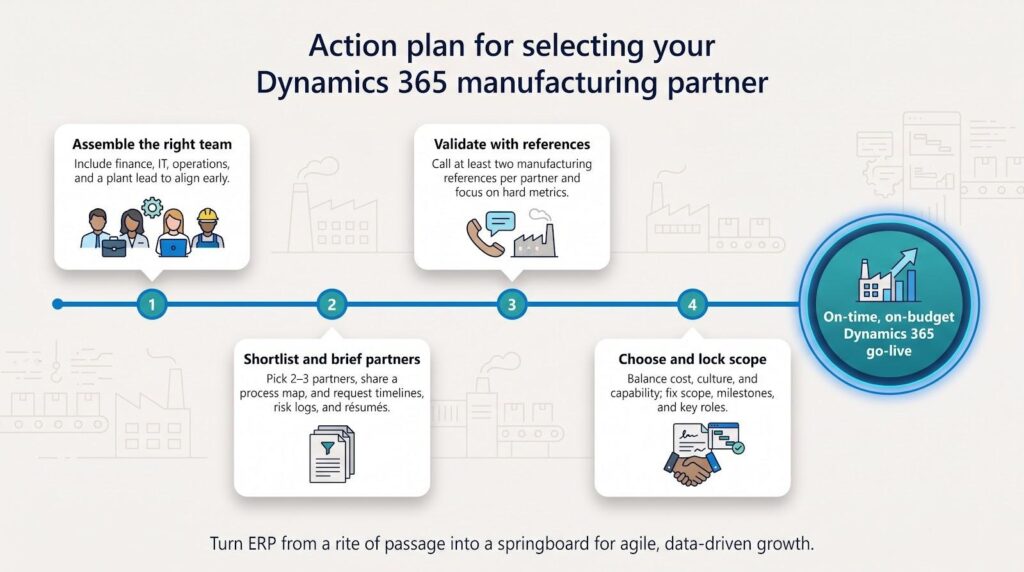
Follow these steps and you join the manufacturers who turn ERP from a rite of passage into a springboard for agile, data-driven growth.
Good luck on your Dynamics 365 journey. The future of your factory looks bright.