














“DevOps is not a goal, but a never-ending process of continual improvement.” — Jez Humble, co-author of The DevOps Handbook
Your software releases take weeks. Your cloud bill keeps climbing with no clear explanation. A security audit just flagged vulnerabilities that have been sitting in your pipeline for months. And somewhere in the background, your competitors are shipping updates daily while you’re still scheduling deployment windows on Friday afternoons.
This is the real reason businesses turn to expert DevOps services & solutions and partner with a reliable DevOps automation company in the USA not because “DevOps” sounds good in a board meeting, but because the pain of NOT having it is impossible to ignore IN 2026.
The numbers back this up. 99% of organizations that have implemented DevOps report positive effects and 61% say it improved the quality of their deliverables.
Many organisations are now investing in DevOps development services in USA to modernise their infrastructure and stay competitive in fast-moving markets.
But what do they actually deliver? This guide simplifies DevOps so you can make a smart buying decision.
Table of Contents
Why Businesses Prefer Outsourcing DevOps
This is especially true for companies leveraging DevOps services US, where speed, scalability, and reliability are critical.
| Parameter | Hiring DevOps Service Providers | Building an In-House DevOps Team |
| Time to Get Started | Quick onboarding with ready expertise and processes in place | Slow hiring cycles, onboarding, and setup time |
| Expertise & Experience | Access to diverse experience across industries, tools, and scaling scenarios | Limited to the experience of hired individuals, may lack exposure |
| Cost Efficiency | Predictable and often lower costs without long-term overheads | High fixed costs including salaries, tools, training, and retention |
| Scalability & Flexibility | Easily scale resources up or down based on project needs | Scaling requires hiring, which is slow and expensive |
| Risk & Reliability | Proven frameworks, best practices, and reduced execution risk | Higher dependency on individuals, risk of knowledge gaps or attrition |
What DevOps Service Providers Actually Deliver
A mature provider offering DevOps engineering services in USA focuses not just on tools, but on delivering measurable business outcomes.
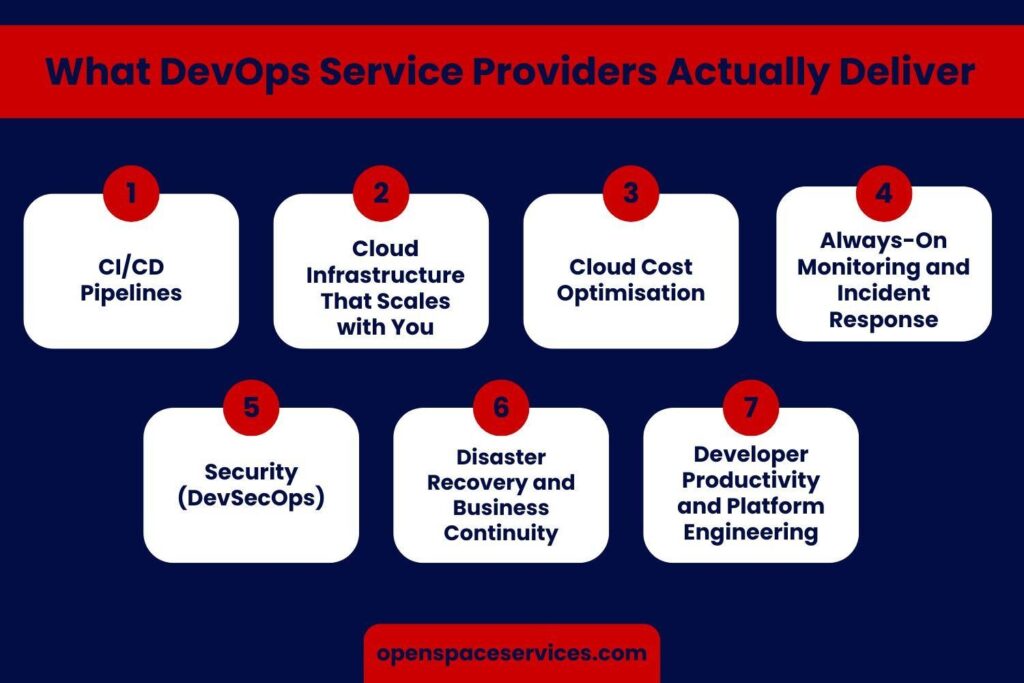
1. A Faster, More Reliable Way to Ship Software (CI/CD Pipelines)
The most visible thing a DevOps provider delivers is a Continuous Integration and Continuous Delivery (CI/CD) pipeline that takes code from a developer’s laptop to production with minimal human intervention. These capabilities are a core part of modern DevOps services & solutions, helping teams move from manual deployments to automated, reliable delivery pipelines.
What this means for your business:
Before a proper pipeline, every deployment is a manual, anxiety-inducing event. Engineers follow checklists, hope nothing breaks, and spend evenings rolling back changes. After a pipeline is in place, deployments become routine, frequent, and low risk.
Automating CI/CD pipelines results in a reduction of delivery time of up to 40% while increasing deployment stability and frequency by about 70%.
Mature DevOps teams see deployment rates improving by 25%, a reduction of 20% in failed changes, and 28% higher productivity through CI/CD automation.
Teams using CI/CD and version control deliver 2.5 times faster than traditional teams, and are 1.4 times more likely to achieve performance targets and satisfy customers.
What the provider actually does:
- Designs and builds automated build, test, and deployment workflows
- Integrates with your existing source control (GitHub, GitLab, Bitbucket)
- Sets up safe deployment strategies like blue-green or canary releases that allow rollback if something goes wrong
- Automates testing so bugs are caught before they ever reach production
The business outcome: You ship faster. You break things less. Your team spends time building, not firefighting.
2. Cloud Infrastructure That Scales with You
A skilled DevOps automation company in the USA ensures infrastructure is scalable, secure, and aligned with business growth.
Most growing businesses have a cloud problem. They either can’t scale fast enough when demand spikes, or they’re massively over-provisioned and paying for resources they don’t use.
A DevOps provider sets up and manages your cloud infrastructure as code, meaning your servers, databases, networks, and security rules are all defined in version-controlled scripts rather than manually configured through a console.
This makes infrastructure reproducible, auditable, and dramatically faster to provision.
What this means for your business:
Infrastructure as Code (IaC) eliminates the “it works on my machine” problem and makes spinning up new environments (for testing, staging, or new product regions) a matter of minutes, not days.
85% of organizations have adopted a cloud strategy, and cloud users are 14% more likely to meet their performance goals.
What the provider actually does:
- Designs your cloud architecture on AWS, Azure, or GCP (or a multi-cloud combination)
- Writes and manages IaC templates using tools like Terraform
- Sets up auto-scaling so your infrastructure grows and shrinks automatically with traffic
- Implements containerization (Docker, Kubernetes) for application portability and efficiency
The business outcome: Your infrastructure is reliable, consistent, and ready to grow with you without a manual bottleneck every time you need a new environment.
3. Cloud Cost Optimisation
Cloud bills are notoriously difficult to control. Resources get provisioned and forgotten. Development environments run 24/7 when they’re only needed during business hours. Premium-tier services sit at 5% utilization.
This is where structured DevOps support services play a key role in maintaining cost visibility and control.
A DevOps provider performs a systematic audit of your cloud spend and implements ongoing cost governance.
One DevOps team working with a global enterprise discovered numerous premium-tier services running at less than 10% utilization. This is just one example out of hundreds that can lead to significant financial loss.
Businesses can save on compute costs simply by choosing the right cloud pricing model.
What the provider actually does:
- Audits your current cloud spend and identifies waste
- Implements resource tagging, budgeting alerts, and cost allocation by team or product
- Right-sizes over-provisioned resources and eliminates orphaned infrastructure
- Sets up automated scheduling to power down non-production environments after hours
- Advises on reserved instances and savings plans
The business outcome: Your cloud bill stops growing uncontrollably, and you get visibility into exactly what you’re spending and why.
4. Always-On Monitoring and Incident Response
You should never hear about a production outage from a customer. A DevOps provider sets up comprehensive monitoring so that problems are detected and addressed before users are affected.
What this means for your business:
According to LinkTek downtime costs organisations more than $26.5 billion annually. The damage isn’t just the immediate lost revenue, it’s also the customer trust that erodes with every outage, and the engineering time burned on emergency response instead of building new features.
What the provider actually does:
- Deploys monitoring across your applications, infrastructure, databases, and user experience
- Sets up log aggregation so engineers can trace the root cause of any issue quickly
- Configures intelligent alerting with escalation policies (no more 3am pages for non-critical events)
- Builds dashboards and defines SLAs/SLOs so your team knows exactly what “healthy” looks like
- Provides incident response runbooks so that when something breaks, engineers know exactly what to do
The business outcome: Problems get caught early. Recovery times drop dramatically. Your on-call engineers stop burning out.
5. Security Built into the Process, Not Bolted on After (DevSecOps)
Security is the area where most growing companies have the largest gap between where they are and where they need to be. The traditional approach of reviewing security at the end of a release cycle simply doesn’t work at modern development speeds.
DevOps providers embed security directly into the development pipeline, a practice called DevSecOps. Vulnerabilities are caught in the code review stage, not after deployment.
These practices are now standard across leading DevOps services US, where security is embedded into every stage of development.
Gene Kim, co-author of The Phoenix Project, emphasizes that security should be a shared responsibility and integrated early into the development pipeline, a core idea behind DevSecOps.
What the provider actually does:
- Integrates automated vulnerability scanning into every code commit and build
- Implements secrets management so API keys and credentials are never hardcoded in source code
- Configures identity and access management (IAM) following the principle of least privilege
- Sets up dependency scanning to flag known vulnerabilities in third-party libraries
- Helps achieve compliance readiness for frameworks like SOC 2, HIPAA, or PCI-DSS
The business outcome: Security issues are caught cheaply, early, and automatically rather than expensively, late, and manually. Your compliance posture improves. Your exposure to breaches decreases.
6. Disaster Recovery and Business Continuity
Most businesses don’t discover the gaps in their disaster recovery plan until they actually need it. A DevOps provider ensures that your backup, recovery, and failover systems are tested, documented, and genuinely functional before disaster strikes.
What this means for your business:
The key metrics here are Recovery Time Objective (RTO: How long until you’re back up) and Recovery Point Objective (RPO: How much data you can afford to lose). Most businesses vastly overestimate how well their current systems perform against these targets.
What the provider actually does:
- Designs and implements automated backup strategies with regular restore testing
- Defines RTO/RPO targets aligned with your business requirements
- Builds multi-region failover architecture for critical systems
- Conducts chaos engineering exercises. This deliberately triggers failures to find weaknesses before real incidents do
- Creates and maintains incident response runbooks and communication plans
The business outcome: When something goes wrong, eventually, your business recovers in minutes rather than days.
7. Developer Productivity and Platform Engineering
One of the less visible but highly valuable things a DevOps provider delivers is improved developer experience. When developers spend hours setting up local environments, waiting for slow test suites, or navigating inconsistent toolchains, they’re not building product.
What the provider actually does:
- Builds internal developer platforms (IDPs) with self-service environment provisioning
- Creates standardized templates and “golden paths” so new projects start correctly by default
- Streamlines onboarding. This allows new engineers to become productive in days, not weeks
- Reduces the cognitive load on development teams by owning infrastructure complexity
The business outcome: Your engineering team is faster, happier, and focused on the work that creates business value.
Also read: 7 Powerful Benefits of DevOps for Mobile App Development Beginners Should Know
Signs Your Business Needs a DevOps Provider

Many of these challenges can be addressed by working with experienced DevOps support services providers. You don’t need to face all these problems. If even a few apply to your business, a DevOps provider is likely worth it.
Delivery is slow and unpredictable. Releases take weeks or months. Deployment dates slip regularly. Your team dreads release day.
Incidents are frequent and costly. Production issues surprise you. Recovery takes hours. Post-mortems keep finding the same root causes.
Your cloud bill is growing faster than your business. You’re spending more on infrastructure every quarter but can’t explain exactly why.
Security is an afterthought. You rely on periodic audits rather than continuous scanning. You’re not sure what’s actually in your dependencies.
You can’t hire fast enough. DevOps talent is scarce, expensive, and often leaves for better offers.

Your team is stuck doing manual work. Developers are managing servers. Operation is manually running deployments. Everyone is doing work that should be automated.
The question isn’t whether DevOps will help. The evidence is overwhelming that it does. The question is whether you build the capability internally or bring in a partner.
The Different Ways You Can Engage a DevOps Provider
These models are commonly offered by companies delivering DevOps development services in USA to suit different business needs. Not all engagements look the same. Understanding the models helps you choose the right fit.
Fully Managed DevOps: The provider takes end-to-end ownership of your DevOps function. They design, build, operate, and continuously improve your infrastructure and pipelines.
Best for: Companies that want to outsource the entire function and focus internal engineering capacity on product.
Staff Augmentation: DevOps engineers are embedded directly in your team, working alongside your existing developers and ops staff.
Best for: Companies that have some internal DevOps capability but need to fill skills gaps or scale quickly.
Project-Based Consulting: A defined engagement with a specific deliverable. This can include a CI/CD pipeline build, a cloud migration, a security audit and remediation.
Best for: Companies that need to solve a specific, well-defined problem.
Training and Enablement: The provider upskills your existing team through workshops, hands-on training, and coaching.
Best for: Companies that want to build lasting internal capability, not ongoing dependency on a vendor.
Also read: 5 Things You Should Know Before Developing a Mobile App
What DevOps Providers Do NOT Deliver
Setting clear expectations prevents frustration. Here’s what a DevOps provider is not responsible for:
- They don’t write your application code.
- They don’t replace your engineering culture.
- They don’t guarantee zero downtime.
- They don’t eliminate the need for internal ownership.
How to Evaluate a DevOps Provider: Questions to Ask
Before signing a contract, ask these questions and pay close attention to how they answer, not just what they say.
“Can you walk us through your incident response process?”
A good provider has a documented, tested process. Vague answers here are a red flag.
“How do you handle the transition period?”
Moving DevOps to a new provider involves real risk. Ask specifically about knowledge transfer, documentation, and cutover planning.
“What does success look like at 90 days, 6 months, and 12 months?”
If they can’t give you concrete, measurable milestones, they’re not serious about accountability.
“Who owns the infrastructure and the code you write?”
The answer should always be: You do. Avoid providers who build in tooling or architecture lock-in.
“What certifications and cloud partnerships do your engineers hold?”
Look for AWS, Azure, or GCP partner status and relevant certifications (Kubernetes, Terraform, etc.).
When to not consider the service provider:
- Overpromising dramatic results without understanding your current state
- Lack of transparency about their toolchain or methodology
- Inability to provide references from businesses of similar size or complexity
- Pressure to lock into long-term contracts before a pilot or assessment phase
The Real ROI: What You’re Actually Buying
When you hire a DevOps service provider, you’re not really buying pipelines and monitoring dashboards. You’re buying:
Speed: The ability to respond to market changes and customer needs faster than your competitors.
Reliability: Systems that work, incidents that resolve quickly, and customers who trust your product.
Cost control: Cloud spend that matches your actual needs, not runaway waste.
Security: Confidence that vulnerabilities are being caught continuously, not just during quarterly audits.
Focus: Your engineering team working on your product, not on plumbing.
According to areport teams implementing DevOps practices experience 46 times more frequent code deployments and 96 times faster recovery from failures compared to low-performing teams.
These aren’t marginal improvements. They’re the difference between a business that can compete and one that can’t.
Final Word
DevOps service providers deliver something deceptively simple: the infrastructure for your business to move faster and break less.
The good news is that you don’t have to build this capability from scratch. The right DevOps partner brings the expertise, the tooling, and the battle-tested processes so you can focus on what only your team can do: building the product that wins the market.
If your systems are slowing you down or scaling feels uncertain, Openspace Services can help. With deep expertise in DevOps, automation, DevOps consulting, implementation and development, cloud DevOps services, DevOps Security, and DevOps managed services their team brings clarity and execution together.
“OpenSpace Services has been an invaluable partner in our project’s success. Their development expertise, commitment to efficient processes, and timely deliverables have significantly improved our website’s user experience.” – Tracy Barley, Lancaster Airport Authority.
Book a consultation with Openspace Servicesto assess your setup, identify gaps, and build a more reliable, scalable, and efficient delivery pipeline.
FAQs
1. What does a DevOps service provider actually do?
A DevOps service provider helps automate and manage your software delivery and infrastructure. This includes setting up CI/CD pipelines, managing cloud infrastructure, improving security, monitoring systems, and optimising costs.
2. When should a business consider hiring DevOps services?
You should consider DevOps services when:
Releases are slow or unpredictable
Cloud costs are rising without clarity
Production issues are frequent
Security is handled too late in the process
If even a few of these apply, investing in DevOps services can significantly improve efficiency and reliability.
3. Is it better to outsource DevOps or build an in-house team?
Outsourcing DevOps is often faster and more cost-effective, especially for growing businesses. Service providers bring ready expertise, proven processes, and flexibility. In-house teams can work well long-term, but require significant time, hiring effort, and ongoing investment to match the same level of experience.
4. How long does it take to see results from DevOps implementation?
Most businesses start seeing improvements within the first few weeks, especially in deployment speed and stability. More advanced outcomes like cost optimization, security maturity, and scalability improvements typically develop over 2–6 months, depending on the complexity of the system.
5. How do I choose the right DevOps service provider?
Look for providers who:
Have real experience with similar scale and complexity
Can clearly explain their approach to CI/CD, cloud, and security
Offer transparent processes and measurable outcomes
Suggest starting with a pilot or audit instead of long-term lock-ins
A good provider focuses on long-term reliability, not just quick fixes.